

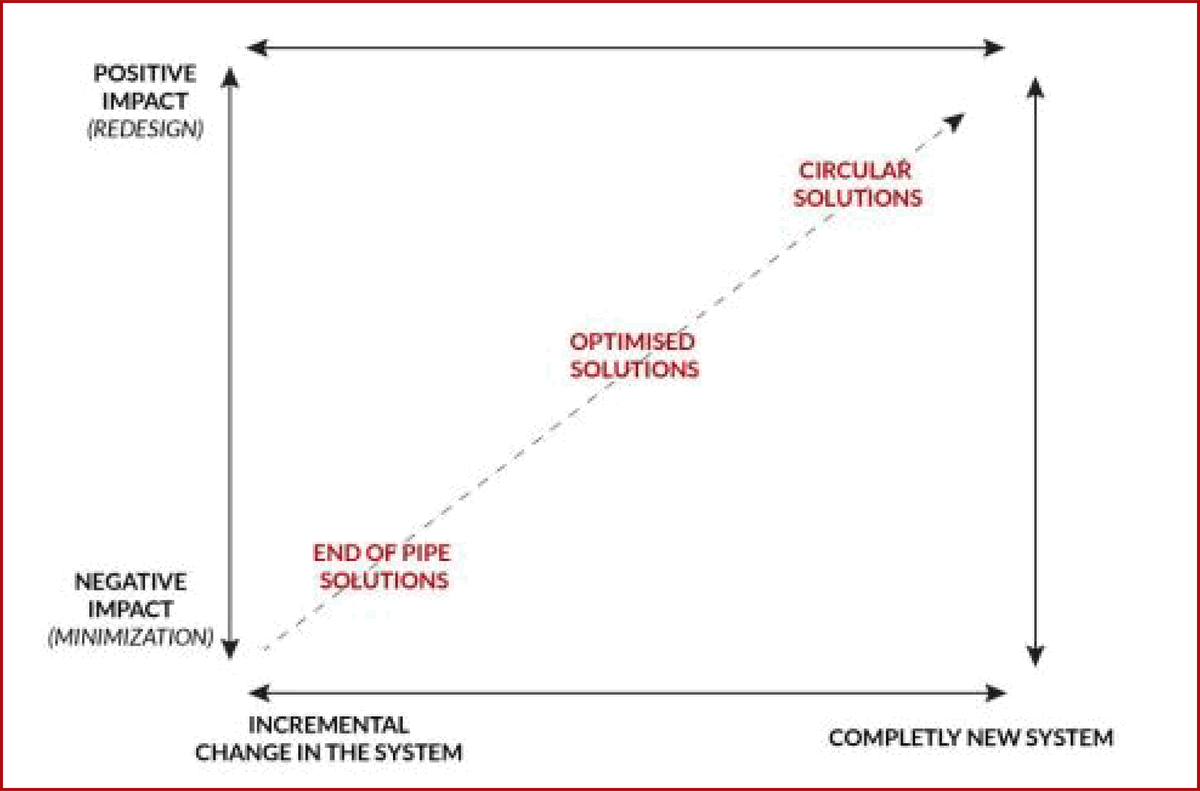
In the process of evaluating and developing EIS, design played a crucial role, addressing both how to improve existing systems and how to create or transform to an entirely new system. Within a circular economy perspective, two different design rationales of eco-innovations can be distinguished: one considers the design of completely circular actions while the other focuses on designing strategies that optimise existing processes towards circularity, minimizing the production of waste and maximizing the re-use/transformation of waste into valuable products. Based on the study of Carrillo-Hermosilla and Könnölä (2010), when these two perspectives are combined with the incremental and/or radical nature of Political, Economic, Social, Technological, Legal and Environmental changes and the degree of impacts to the systems, three different types of actions can be proposed to help the transition towards circularity (REPAiR 2018, p. 15).
For further information:
https://h2020repair.eu/wp-content/uploads/2019/03/Deliverable-5.2-Catalogue-of-solutions-and-strategies-for-Amsterdam.pdf
https://h2020repair.eu/wp-content/uploads/2019/10/Deliverable-5.3-Eco-Innovative-Solutions-Naples.pdf